
Should You Repair or Replace Your Gutters?
Should you repair or replace gutters on your Biloxi home? This guide walks homeowners in 39530 and 39531, from Old Biloxi to the Back Bay, through the deciding checks: system age, rust, repeat seam leaks, sagging runs and fascia damage — with honest answers for each.
Repair when the damage is local and the metal is sound. Replace when the problems are everywhere, or keep coming back. That one rule settles most cases of "should I repair or replace my gutters." This guide walks through the warning signs, the two tests we actually use on Biloxi homes, and what each path costs, so the decision comes from the condition of your system instead of a sales pitch.
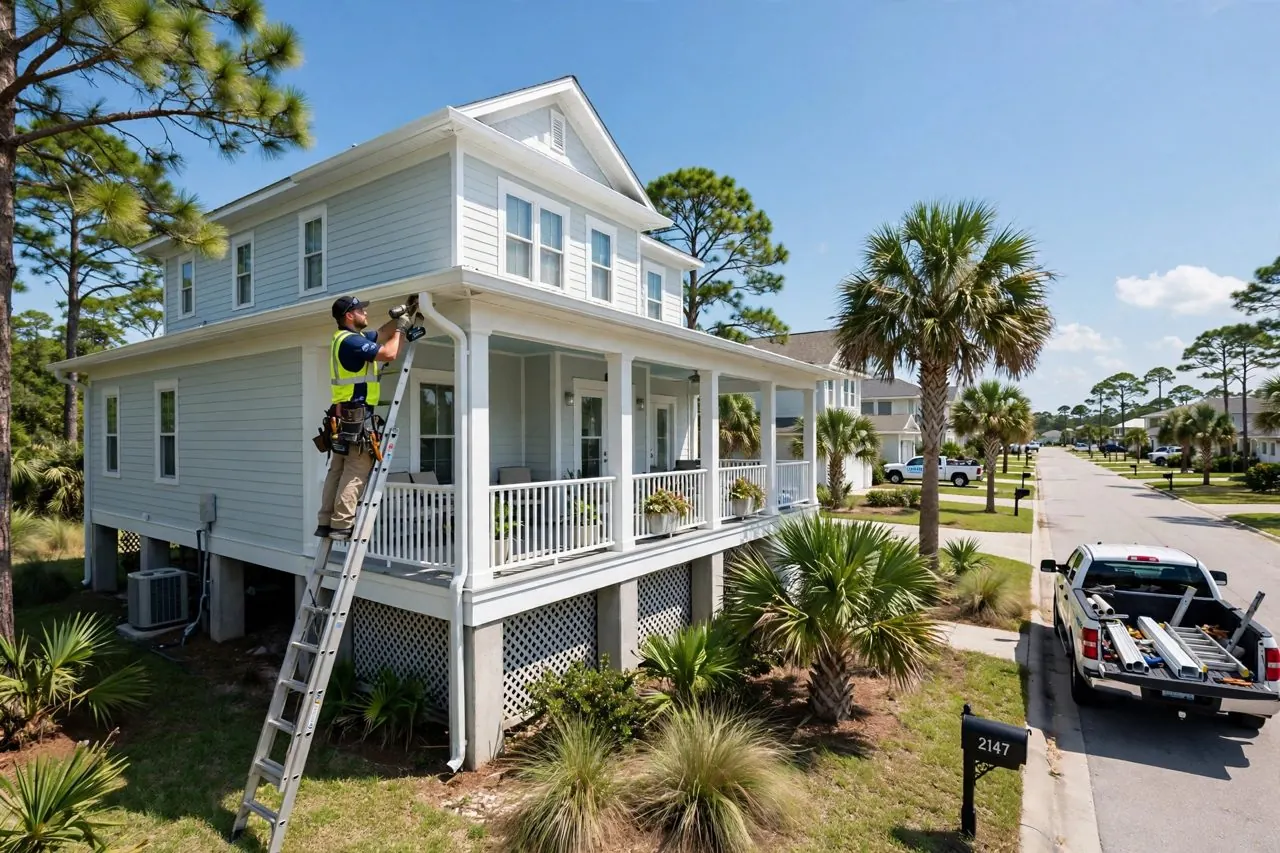
Start with the warning signs
Before the repair-or-replace question comes the "is something wrong at all" question. These are the signs that a system needs attention of one kind or the other:
- Water pooling at the foundation after rain, or puddles that linger along one wall — discharge or drainage is failing somewhere.
- Peeling paint on siding or trim directly under the roofline, where overflow has been soaking it.
- Mildew stains or a musty smell along exterior walls, the residue of water going down the wall instead of down a downspout.
- Sagging or detached sections, gutters pulling away or running crooked — hardware or the wood behind it is giving up.
- Drips at corners and seams during rain, the classic seal failure.
Our companion guide on the signs you need new gutters goes deeper on the replacement-side symptoms. Here, the question is what to do once you know something is wrong.
When repair is the right call
Repairs solve more gutter problems than most homeowners expect, especially caught early:
- Small cracks, holes, and leaking corners — resealing or a section patch restores the run.
- Loose hangers or a single sagging run — re-hanging and re-pitching is a one-visit fix.
- Storm damage on one side of the house — the other elevations were never touched; see our storm damage gutter repair page.
- One crushed downspout or a clog that will not clear — component problems, not system problems.
- A system under 15 years old whose metal still rings sound when you tap it.
Full detail on what each of those fixes involves is on our gutter repair page. The pattern to notice: every item is in one place, and the rest of the system is fine.
When replacement is the right call
- Rust or cracks across most runs, not just one corner — the metal itself is done.
- Sagging everywhere, with hangers pulling out of fascia that has gone soft on several sides.
- Sections missing or torn off that expose how tired the remaining metal is.
- The same problems returning every season despite honest repairs.
- A system too small for the roof it drains — builder-grade 5-inch gutters on a large Biloxi roof will overflow in Gulf downpours no matter how well they are repaired. That is a sizing failure, and only replacement fixes sizing.
Looking at two or more signs from the second list? Get both numbers in writing before you spend on either.
Call (228) 888-8061The Three Questions That Decide It: Age, Failure Points, Repair History
The spread test
Walk the house and count elevations. Damage on one side, with the other three sound, points to repair almost every time. Damage showing on three or four sides — rust here, sagging there, a corner gone somewhere else — means the system is failing as a system, and repairing it means paying for the same decline four times.
The spend test
Add up the last two or three seasons of gutter repairs. Most single repairs run $100 to $450, averaging about $275, and occasional repairs at that level are just ownership. But when the running total starts approaching a large share of a new system — seamless aluminum installed at $6 to $13 per linear foot, roughly $900 to $2,600 for the 100 to 200 feet most Biloxi homes need — the repairs have stopped being the cheap option. At that point replacement is not the expensive choice; it is the end of a recurring bill. Our Biloxi gutter cost guide lays out both sets of numbers in full.
Biloxi factors that move the decision
Two local realities shorten the debate here. Salt air corrodes fasteners and cut edges faster than inland weather does, so a coastal system can be structurally older than its years, especially within a few streets of the beach. And hurricane seasons, June 1 through November 30, test whatever weakness exists: a run that is merely tired in April can be on the ground in September. If the spread test is borderline in spring, Biloxi weather argues for settling it before the season opens rather than after it closes.
Repair vs. Replacement at a Glance
| What you see | Usually repair | Usually replace |
|---|---|---|
| Leaks | One seam or corner | Leaks across several runs |
| Metal condition | Sound, with isolated damage | Rust, cracks or thinning in many places |
| History | First occurrence | Same failures returning each season |
| Support | One loose hanger or short sag | Hangers pulling from rotted fascia |
| Capacity | Overflows only when clogged | Overflows clean because it is undersized |
Count the separate failure points. One problem in one place is a repair story. Three or more failures on a run — especially with a repeat repair in its history — usually means the system is telling you it is finished.
The Short Answer
| Situation | Verdict |
|---|---|
| One leaking corner, metal sound | Repair — reseal |
| One sagging run, fascia solid | Repair — re-hang and re-pitch |
| Storm damage, one elevation | Repair — replace the damaged sections |
| Rust or cracks on most runs | Replace |
| Problems on three or four sides at once | Replace |
| Repairs needed every season, totals climbing | Replace |
| Clean, sound gutters that overflow in heavy rain | Replace or upsize — it is a capacity problem |
When replacement wins, a modern seamless gutter installation removes most of the failure points on the repair list at once: no seams to reseal every few years, hangers screwed into solid wood, sizing chosen for Biloxi rain instead of inherited from a builder.
Frequently asked questions
How long do gutters last?
A typical aluminum gutter system lasts about 20 to 30 years, with seamless systems generally outlasting sectional ones. Biloxi’s salt air, storm exposure, pine debris and maintenance habits decide where a particular system lands in that range.
When is a gutter repair a waste of money?
Repair is a poor spend when the same seam keeps failing, rust or cracks appear across several runs, hangers are pulling out of soft fascia, or the system is so undersized that it overflows even when clean.
What is the “half rule” for repair vs. replacement?
It is a comparison, not a law: when a repair approaches roughly a third to half the cost of replacement and the system is already old or failing in several places, replacement usually buys more remaining life. Age and condition still decide.
Can I replace just one damaged section?
Yes, when the rest of the system is sound. A crushed or rusted section can be replaced and matched to the existing run, while healthy elevations are left alone. The inspection should show you exactly where that line falls.
My seam was resealed once and leaks again — repair or replace?
A second failure at the same seam points to movement, poor pitch, deteriorated metal or a joint that can no longer hold sealant. One careful reseal may be reasonable; repeated leaks are evidence the section or system is done.
Should I add gutter guards when I replace?
Replacement is the easiest time to add them, especially under Biloxi pines. Choose guards for your debris — micro-mesh for pine needles — but size the gutters and downspouts correctly first, because a guard cannot fix an undersized system.
Still asking "should I repair or replace my gutters?"
Bring us out for a look. You get the repair number and the replacement number in writing, and the decision stays yours. If you are still deciding whether to repair or replace gutters, let the condition of the whole system decide.
Call (228) 888-8061Related: Signs you need new gutters · Gutter replacement in Biloxi · Gutter installation in Biloxi, MS