
Why Do Gutters Overflow in Biloxi? 5 Causes & Fixes
Water spilling over the front lip is a symptom, not a diagnosis. This guide works through why do gutters overflow in Biloxi homes — clogs, lost pitch, undersized runs, blocked downspouts, pulled-away gutters — for homes in 39532 and 39530, from Woolmarket pines to Back Bay rooflines, naming each fix.
The short answer to why do gutters overflow in Biloxi is that one of five things has failed. A clog dams the trough, a blocked downspout backs the whole run up, lost pitch strands water in low spots, an undersized system cannot carry a Gulf downpour, or the gutter has pulled away from the fascia so water misses the channel entirely. Find which one matches what you see, and the fix follows from it.

The Five Causes, in the Order to Check Them
Check in this order because the cheap, common causes come first. Every answer to why do gutters overflow in Biloxi fits one of these five buckets, and the order below runs from the most common to the most structural. A cleaning fixes a clog; it does nothing for a run that lost its pitch, and a new gutter does nothing for a downspout blocked at the elbow. Work down the list until the symptom matches.
1. Clogs in the trough
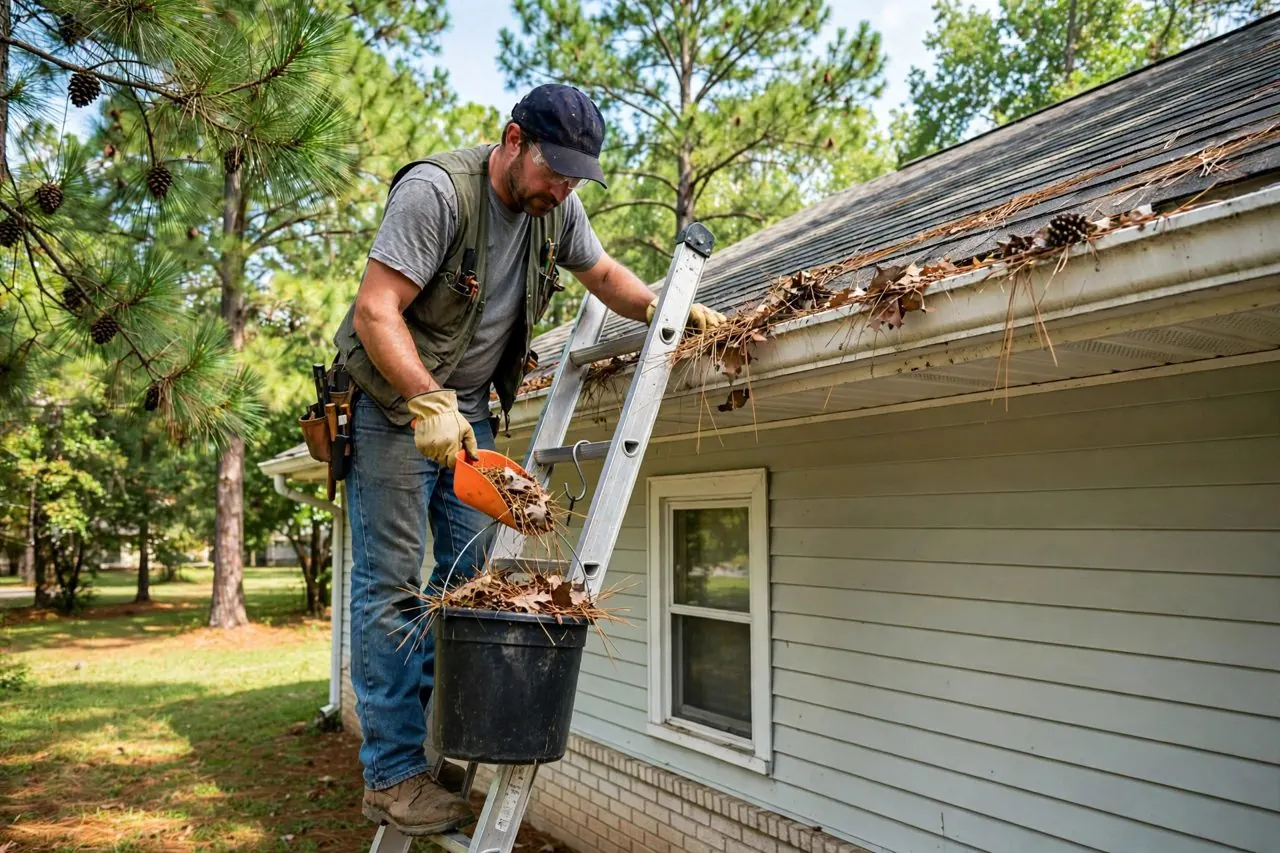
The most common cause, and the Biloxi version is worse than the national one. Longleaf pines shed needles all year, oaks drop leaves and tassels, and roofs shed grit; a summer storm then washes a season of it into the trough at once. The debris compacts into a mat that dams the flow, so the trough fills and spills over the front edge even in ordinary rain. If overflow started gradually and got worse over months, this is the first suspect. The fix is a full gutter cleaning that clears the trough and flushes the outlets — and if the mat keeps coming back under the same trees, guards fitted to a clean system are the longer answer, as our pine-needle guide explains.
2. A blocked downspout
This one fools people, because the trough can look clear while the system still overflows. Debris that passes the trough lodges in the downspout elbows, and the blockage backs water up the whole run until it spills at the nearest low point — often a corner, well away from the actual clog. If overflow concentrates near one outlet, or water gushes at the top of a downspout while nothing comes out at the bottom, the blockage is in the pipe, not the trough. Clearing it means taking the downspout apart at the elbows, not just scooping the gutter above it.
3. Lost pitch or a sagging run
Gutters are not level; they fall gently toward the downspout, roughly a quarter inch per ten feet of run, so gravity does the work. When hangers loosen or debris weight sags a section, the fall flattens or reverses, and water pools in the low spot instead of draining. Standing water then collects more debris, which adds more weight, which deepens the sag — the cycle feeds itself. If you see water sitting in the trough hours after rain stops, or overflow at the middle of a long run rather than near an outlet, pitch is the suspect. The fix is a gutter repair visit: re-support the run, replace failed hangers with hidden brackets screwed into solid wood, and re-set the fall toward the downspout.
4. An undersized system or too few downspouts
A system that overflows only in heavy rain, while staying dry in light rain, is usually a capacity problem rather than a clog. Builder-grade 5-inch gutters and a single downspout on a long run cannot carry what a large or steep Biloxi roof sheds in a Gulf downpour, and adding a downspout or two splits the load the same way a second drain empties a tub faster. This is the cause most often misdiagnosed as a cleaning problem: the trough is clean, the pitch is right, and the water still pours over the lip, because the system was never sized for the roof above it. The fix is a seamless gutter installation sized to the roof plan — usually 6-inch with larger downspouts — rather than another cleaning of a system that was never big enough.
5. Gutters pulling away from the fascia
When fasteners pull out of soft or rotted fascia, the gutter tilts forward and roof water overshoots the channel entirely, running down the siding instead of into the trough. You will see a visible gap behind the gutter, drip lines on the siding, and often a section that visibly leans. This is the most urgent of the five, because every storm that runs behind the gutter soaks the fascia further. The fix starts with the wood: repair the soft fascia first, then re-hang the gutter on solid material, or the new fasteners will pull out exactly like the old ones did.
How to Tell Which Cause Is Yours
Most of the diagnosis happens from the ground, without a ladder. Watch the system during the next rain, then check it again an hour after the rain stops:
- Overflow everywhere, worse over time — clogs. Book a cleaning before the standing water starts on the fascia.
- Overflow at one corner, nothing at the downspout base — blocked downspout at that outlet.
- Water sitting in the trough after rain stops — lost pitch or a sagging run.
- Overflow only in hard downpours, clean trough — undersized system or too few downspouts.
- Visible gap behind the gutter, water down the siding — pulling away from the fascia; get it looked at before the next storm band.
If two symptoms show at once — a sagging run that is also clogged, for instance — fix the structure first and the debris second, or the clog will return to the same low spot.
What Overflow Does If You Leave It
Overflow is not cosmetic. Water spilling at the fascia keeps the wood damp between storms, and damp fascia softens until fasteners no longer hold — which is how a cleaning problem becomes a repair problem. Water dumping at the foundation washes soil away from the slab and leaves the siding stained where it repeatedly runs. None of that happens in one storm; it is the accumulation across a wet season that turns a small fix into a larger one. That is why the honest urgency test is simple: if the overflow is new, a cleaning or a repair visit settles it; if it has run all season, ask for the fascia to be checked as part of the same visit.
When to Call Instead of Watching Another Storm
Call when the cause is structural — sagging, pulling away, or a capacity problem — or when a cleaning has already been done and the overflow came back. A visit starts with the measurement and the fascia check, not with a quote for the most expensive option: a clog gets a cleaning price, a pitch problem gets a repair price, and only a genuinely undersized system gets a replacement price. The third answer to the question of why do gutters overflow in Biloxi homes is the one that costs the least to confirm and the most to ignore — standing water in the trough, week after week, is the fascia quietly softening.
Frequently asked questions
Why do my gutters overflow even though they look clean?
Because the problem is usually not debris. A clean trough that still overflows points to lost pitch, a blocked downspout lower in the pipe, or a system too small for the roof above it. Check whether water sits in the trough after rain stops, and whether anything comes out at the downspout base.
Why do gutters overflow only in heavy rain?
Capacity. A system that handles light rain and fails in a downpour is undersized for the roof, short on downspouts, or both. Cleaning will not fix it, because there is nothing blocking the flow — there is simply more water than the channel can carry.
Why does only one corner of my gutter overflow?
Usually a blocked downspout at that corner, or a low spot in the pitch on that run. Water backs up from the blockage or pools in the sag and spills at the nearest edge, which is often well away from where the real problem sits.
Will gutter guards stop my gutters from overflowing?
Only if debris is the cause. Guards keep needles and leaves out of a correctly sized, correctly pitched system. They do not fix lost pitch, a blocked downspout, or an undersized gutter — and a flat screen under pines can itself sheet water over the lip in a downpour.
How urgent is an overflowing gutter in Biloxi?
More urgent than it looks. Overflow that runs all season soaks the fascia and washes soil at the foundation, turning a cleaning or repair job into fascia work. If the gutter is pulling away from the house, or the overflow has run for months, get it looked at before the next storm band rather than after it.
Still watching water pour over the lip?
Call for a diagnosis anywhere in Biloxi — from pine-heavy Woolmarket to Back Bay. If it is a clog, you get a cleaning price; if it is pitch, size or fascia, you hear that before anything is quoted.
Call (228) 888-8061Related: Gutter guards for pine needles · Gutter installation in Biloxi, MS