
Gutter System Parts in Biloxi: Names & What They Do
This guide to gutter system parts Biloxi MS homeowners run into starts with one idea: a gutter is a system, not a trough. From Woolmarket to Back Bay, homes in 39532 and 39530 rely on the parts (trough, hangers, outlets, and downspouts) working to move Gulf rain away from houses.
The short answer is that gutter system parts Biloxi MS homes depend on fall into three jobs: catch, carry, and release. The trough catches roof water; hangers, miters, and end caps hold and shape the run; outlets, elbows, and downspouts carry it to the ground and release it clear of the foundation. When one part fails, the symptom usually names the part — which is why knowing the names turns a confusing problem into a precise call.
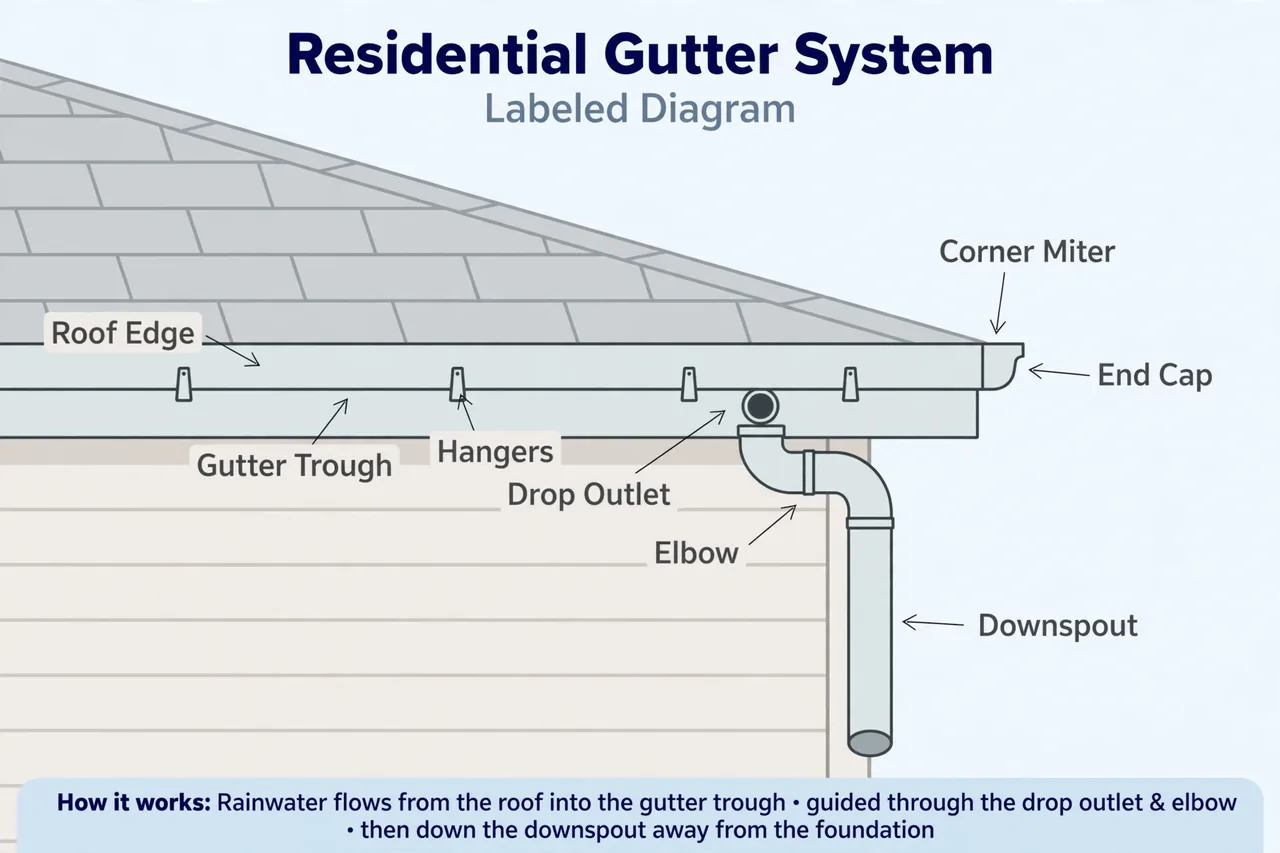
Follow the Water: the Parts in Order
Walk the path a raindrop takes and you meet every part of the system once. The sections below follow that path, from the roof edge to the ground, and the table at the end of the section names each part's job and its usual failure sign. Read this as a vocabulary lesson first — the repair, cleaning, and installation guides linked through the post cover the fixes.
The roof edge: drip edge and fascia
Before water reaches any gutter part, it crosses the drip edge — the metal flashing at the roof's edge that hands runoff into the trough instead of letting it curl back behind the gutter and down the wall. Behind the drip edge sits the fascia board, the flat trim board along the roof edge that the gutter hangers screw into. The fascia is not a gutter part, but the whole system hangs on it: if the board is soft from years of water running behind the trough, hangers cannot hold their grip or their pitch, and no new gutter will hang straight on it. That is a fascia and soffit repair job first, and a gutter job second.
The trough: the part everyone calls “the gutter”
The trough is the open channel that catches roof water and carries it sideways to an outlet. On a seamless system it is one continuous piece along each straight stretch, formed on site to the measured length — which is why a seamless run has no mid-run joints for water to find. Size is a separate question from type: width and downspout size decide how much water the trough can carry, and on Biloxi roofs the larger profile with wider downspouts is the usual answer for Gulf downpours. Our seamless gutter installation service sizes the trough from the roof plan, not from a guess.
Hangers: the part that holds the pitch
Hangers are the brackets that fasten the trough to the fascia and hold its slight slope toward the outlet. Modern systems use hidden hangers — brackets that sit inside the trough and screw into the fascia, out of sight — while older systems use spikes driven through the front of the trough into the fascia. Either style only works when the brackets are sound and spaced along the run: a bracket that loosens, corrodes, or pulls out of soft fascia lets its section of trough drop, and a dropped section stops draining.
Miters and end caps: corners and full stops
Where the roofline turns a corner, two runs meet at a miter — an angled fitting that joins them so water flows around the turn without leaving the trough. Where a run ends, an end cap seals it shut so water cannot pour out sideways. Both are sealed joints, and both are the parts most likely to drip as a system ages, because the sealant at a joint dries, shrinks, and cracks under sun and temperature change. A drip at a corner points at a miter; a drip at a run's end points at an end cap.
Drop outlet and elbows: the turn
The drop outlet is the shaped opening in the bottom of the trough where water leaves the horizontal run and enters the vertical downspout. Elbows are the bent fittings that turn the downspout from the trough's direction to the wall's direction and around trim. Outlets and elbows are the narrowest points in the system, so they are where debris collects first: pine needles mat across an outlet opening, and roof grit settles in an elbow's bend. A run that overflows right above a downspout usually has a clogged outlet or elbow, not a failing trough.
Downspout and straps: the delivery
The downspout is the vertical pipe that carries water from the outlet to the ground, and straps — also called cleats or brackets — hold it against the wall so wind and water weight cannot pull it loose. At the base, the water still has to get clear of the foundation: a downspout that ends at the wall has moved the problem, not solved it. Our downspout installation service plans the discharge with the slope of the yard, so the delivery ends where water cannot come back at the slab or the pilings.
Guards: the optional part on top
A gutter guard sits over the trough and keeps debris out while letting water through. It is the only part that is genuinely optional, and it changes the cleaning schedule rather than the system underneath: the trough, hangers, miters, outlets, and downspouts are all still there, doing the same jobs. Under Biloxi pines, the guard design matters more than the guard idea — fine mesh stops needles where wide screens and foam let them through — but no guard removes the need to check outlets and hangers.
| Part | Job | First failure sign |
|---|---|---|
| Drip edge | Hands roof water into the trough | Streaks on the wall behind the gutter |
| Fascia board | Anchors the hangers | Gutter pulling away, soft or rotted board |
| Trough | Catches and carries roof water | Overflow along a straight run |
| Hangers | Hold the trough and its slope | Sagging or uneven sections |
| Miter | Joins runs at a corner | Drip at a corner |
| End cap | Seals a run's end | Drip at a run's end |
| Drop outlet | Connects trough to downspout | Overflow right above a downspout |
| Elbows | Turn the downspout | Slow draining, gurgling, overflow at the turn |
| Downspout and straps | Carry water to the ground | Water pooling at the wall, loose pipe |
That is the full cast of gutter system parts Biloxi MS roofs carry: a trough to catch, hangers to hold, miters and end caps to shape and seal, an outlet and elbows to turn, and a downspout to deliver. No single part matters on its own; the system works because each one hands water to the next without a gap.
How the Parts Work Together in a Biloxi Downpour
A gutter system is sized as a chain, and a downpour tests every link at once. The trough must be wide enough for the roof plane above it, the outlet must be clear enough to pass what the trough collects, and the downspout must be wide enough to carry it down without backing up. When one link is smaller or slower than the rest, water queues behind it and spills at the weakest point — usually over the trough edge nearest the clog or the undersized part.
Pitch is the quiet part of that chain. A run is hung with a slight slope toward its outlet, so water moves instead of standing. Lose the slope — because hangers loosened or fascia softened — and water stands in the trough, adds weight, loosens more hangers, and spills at the low edge. That is how a hanger problem becomes an overflow problem, and why an overflow is worth checking at the hangers as well as at the outlet.
Pine needles are the Biloxi multiplier. Needles wash into the trough, ride to the outlet, and mat across its opening or pack into an elbow's bend, and a needle mat can choke an outlet that looks clear from the ground. Homes under pines in Woolmarket and the North Biloxi corridors see this first, and it is the reason a gutter cleaning service visit checks outlets and elbows specifically, not just the open trough.

Reading a Symptom Back to the Part
Most gutter calls start with a symptom, not a part name. The table below works backward from what you can see from the ground to the part most likely responsible. It is a starting point for a conversation, not a diagnosis — two parts can share one symptom, and a run can carry two problems at once.
| What you see | Likely part | What to do next |
|---|---|---|
| Drip at a corner during rain | Miter seal | Reseal or replace the miter fitting |
| Drip at the end of a run | End cap seal | Reseal or replace the end cap |
| A section sags or pulls away | Hangers, or the fascia behind them | Refasten hangers; check fascia first |
| Overflow right above a downspout | Outlet or elbow clog | Clear the outlet and elbows |
| Water pooling at the wall | Downspout discharge | Move discharge clear of the foundation |
| Streaks on siding behind the trough | Drip edge, pitch, or fascia | Check edge flashing, slope, and fascia |
If the symptom is overflow and you want the full check in order, our overflow diagnosis post walks through the five causes — clogs, blocked downspouts, lost pitch, undersized runs, and pulled-away gutters — and names which part each cause points at.
Which Parts Wear Out First on the Gulf Coast
Sealant goes first. The joints at miters and end caps are sealed, and sealant ages under sun and temperature change, so a system that was watertight at installation can start weeping at its corners years later without any single storm to blame. That slow failure is also the easiest to miss, because a corner drip only shows during rain and dries between storms.
Hangers go second, and usually with help. A run carrying standing water or a season of debris weighs more than its brackets were holding when clean, and the extra weight works loose brackets out of fascia that is itself softening where water has run behind the trough. The three — debris, weight, and soft fascia — arrive together, which is why a sagging run is rarely a one-bracket fix. When a run reaches that point, a gutter repair in Biloxi visit should check the hangers, the fascia, and the pitch together, not just the sagging section.
Outlets clog first and most often, but a clog is maintenance, not wear: needles, grit, and shingle granules arrive with every rain and collect where the system narrows. The parts that genuinely wear — seals, brackets, and fascia — fail slowly and quietly; the parts that clog fail loudly and suddenly, which is why the loud problem usually gets fixed first while the slow one keeps working.
What to Note Before You Call
When you call, name the part if you can: the gutter system parts Biloxi MS homes share are few enough that one name — miter, outlet, hanger — tells the crew where to look first. Note which part looks wrong, where on the house it sits, and what you see: a drip, a sag, an overflow, or pooling at the wall. A photo taken from the ground helps more than a guess from a ladder, and no one needs to climb to describe a symptom well.
Also note what the system already is, if you know it: seamless or sectional, and whether guards sit on top. A sectional run with a leaking joint and a seamless run with a clogged outlet are different jobs with different fixes, and the part names in this guide are the shortest way to say which one you have.
Frequently asked questions
What are the main parts of a gutter system?
The trough that catches roof water, hangers that hold it to the fascia, miters that join runs at corners, end caps that seal run ends, a drop outlet that connects the trough to the downspout, elbows that turn the downspout, the downspout itself, and straps that hold it to the wall. The fascia board and drip edge sit beside the system at the roof edge and affect how securely it hangs.
What is a drop outlet on a gutter?
The fitting where the trough meets the downspout — a shaped opening in the bottom of the trough that hands water into the vertical pipe. It is also the first place debris collects, because everything the trough carries arrives at the outlet before it can leave. Under Biloxi pines, needle mats at the outlet are a common cause of overflow near a downspout, and clearing the outlet is often the whole fix.
What do gutter hangers do, and why do gutters sag?
Hangers fasten the trough to the fascia board and hold its slight slope toward the outlet. A run sags when hangers loosen, corrode, or sit too far apart, or when the fascia behind them softens — and a sagging run also loses its slope, so water pools instead of draining. Debris weight makes the problem worse, which is why a sagging run is worth a cleaning and hanger check together.
What is the difference between a miter and an end cap?
A miter joins two gutter runs where the roofline turns a corner, so water flows around the turn without leaving the trough. An end cap seals the open end of a run where the roofline stops, so water cannot pour out sideways. Both are sealed joints, and both are leak points when their sealant ages — corners drip at miters, run ends drip at end caps.
Which gutter part should I check first when water overflows?
Start at the outlet and elbows nearest the overflow, because clogs gather there first — especially pine needles, which mat across the outlet opening. If the outlet runs clear, look at the run's slope and hangers next: a run that has lost its pitch holds water instead of moving it. Our overflow guide walks the full five-cause check in order.
Not sure which part is failing?
Call for a measurement anywhere in Biloxi — from Woolmarket to Back Bay. Name the symptom and the part if you can; the visit settles the rest.
Call (228) 888-8061Related: 5-inch vs 6-inch gutters · How long do seamless gutters last? · Gutter installation in Woolmarket · Gutter installation in Biloxi, MS