
How Do You Unclog a Downspout in Biloxi?
This guide to how to unclog a downspout in Biloxi works the clog points in order, from the gutter outlet to the discharge, so you clear the blockage without damaging the pipe. For homes in 39532 and 39530, from Woolmarket's pine lots to the Back Bay shoreline, the sequence applies.
The short answer is that how to unclog a downspout in Biloxi comes down to working from the bottom up: clear the bottom elbow first, flush gently upward, and only then work from the top or reach for a snake. Most clogs sit in an elbow, not in the straight run, so the order matters more than the force. Start low, use ordinary hose pressure, and stop the moment the job needs a ladder you cannot set safely or a drain you cannot see.
First, make sure the downspout is the problem
A gutter that overflows does not always mean a blocked downspout, and a blocked downspout does not always show itself as overflow. Before you climb anything, watch the system in the next rain — or run a hose into the gutter near the outlet at low flow and watch what happens below. The pattern tells you where the blockage is, and it tells you whether this guide is even the right fix. Our overflow guide covers the other causes — lost pitch, an undersized run, a gutter pulling away — that no amount of downspout clearing will fix.
These are the signs that point at the downspout itself. Water spills over the gutter right above one downspout while the rest of the run drains normally. Water gushes from an elbow joint instead of coming out at the discharge. The downspout stays dry in rain while the gutter above it fills. Or the discharge trickles when every other downspout on the house runs full. Any one of those means the pipe below the outlet is obstructed somewhere between the gutter and the ground, and the rest of this guide applies.
The opposite pattern points elsewhere. If the whole run overflows along its length, suspect pitch or sizing, not a single clog. If water runs behind the gutter and down the wall, suspect hangers or fascia, and our sagging guide separates a watch item from an urgent one. If every downspout on the house is slow, the problem may be a season of debris across the whole system, and a full gutter cleaning visit is the honest starting point rather than one pipe at a time.
The five places a downspout clogs
A downspout is not one tube; it is a path with five choke points, and debris collects where the water changes direction or slows down. Knowing the five points before you start is what keeps you from pushing a clog deeper while trying to clear it. Work them in the order below, lowest first, and check the discharge after each step — the moment water runs free, you are done, and anything after that is unnecessary wear on the pipe.
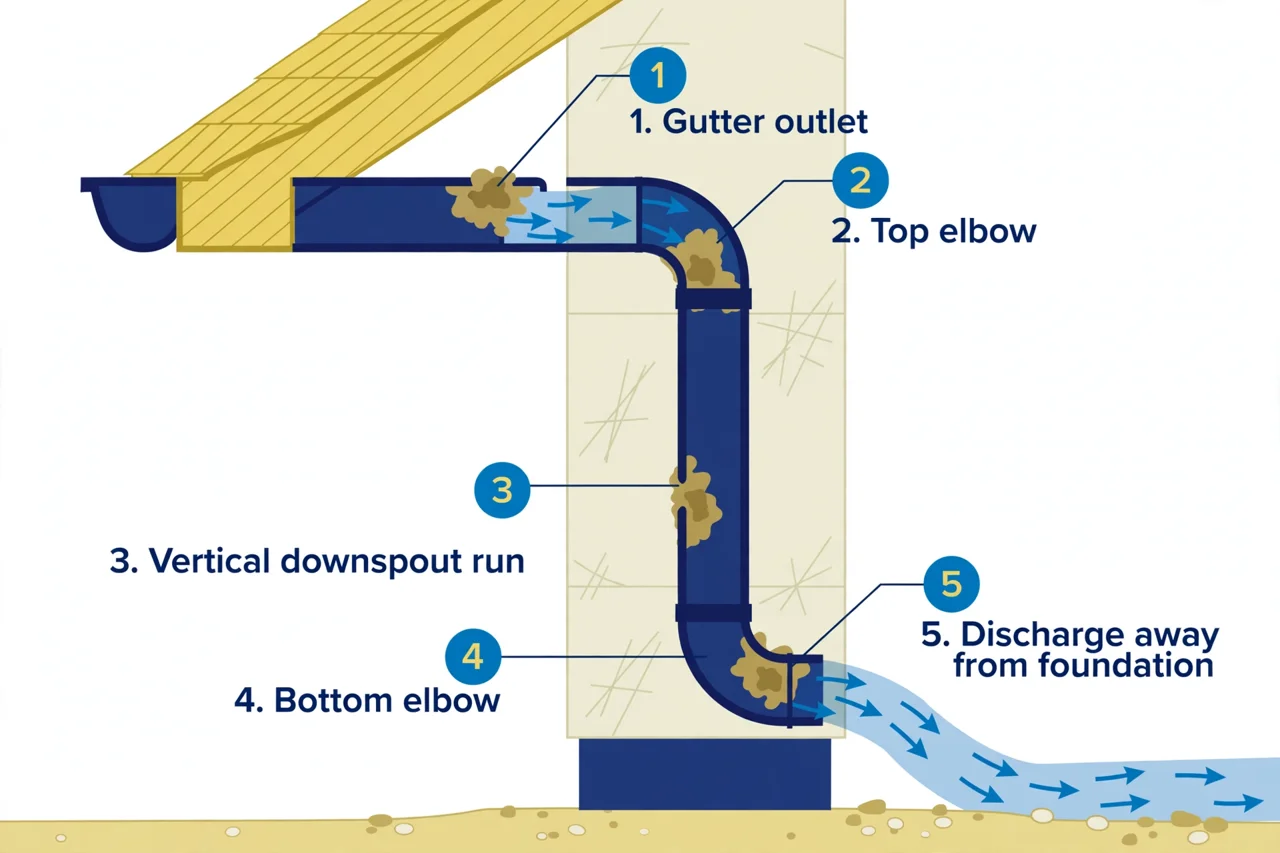
| Clog point | What collects there | What you notice |
|---|---|---|
| 1. Gutter outlet | Leaves, pine needles, and roof grit washed to the one hole in the trough | Gutter fills above one downspout; the pipe below stays dry |
| 2. Top elbow | Needle mats and grit packed into the first tight turn under the outlet | Water backs up into the gutter or weeps from the elbow joint |
| 3. Vertical run | Compacted debris columns, usually where a long straight section narrows at a joint | Slow discharge that no elbow clearing fixes |
| 4. Bottom elbow | The heaviest grit and leaf matter, settled like a sandbag in the last turn | Discharge trickles or stops while the pipe above feels full |
| 5. Discharge and underground drain | Leaves, soil, and roots at the outlet, or a buried pipe filled with silt | Water clears the pipe but pools at the foundation instead of running away |
Under Biloxi pines the pattern has a local shape. Longleaf and loblolly needles do not behave like broad leaves: they mat together, especially when wet, and a needle mat at an elbow can seal a downspout as completely as a handful of leaves. That is why homes in Woolmarket, along the Popps Ferry corridor, and around Cedar Lake — the pine-heavy pockets of the city — see downspout clogs more often than homes with only broadleaf trees, and why the elbow steps below matter more here than the straight-run steps. Our pine-needle guard guide explains which guard types actually keep needles out; no guard makes the elbows immune, but the right one changes how often they pack.
The method, in order
The method below is how to unclog a downspout in Biloxi step by step, in the order that protects the gutter and the pipe. Each step is also a test: if it restores full flow at the discharge, stop there. The most common mistake is starting at the top with full hose pressure, which drives the clog down into the bottom elbow and packs it tighter. The second most common is treating a downspout like a drainpipe that can take any force — thin aluminum dents, joints separate, and a dented elbow becomes a permanent choke point.
1. Clear the bottom elbow by hand
Start at the ground, where no ladder is needed. Reach into the discharge opening with a gloved hand or a plastic putty knife and scoop out whatever is in reach, then tap the elbow lightly with your palm — a few taps break up compacted matter, while hammering dents the metal. Many bottom elbows are held by small sheet-metal screws; removing the elbow gives you a straight shot at the clog and is often the whole job. Support the downspout with one hand while you work so you are not prying on the gutter connection above. If the elbow comes off, clear it, flush it, and refasten it with corrosion-resistant screws.
2. Flush gently from the bottom up
With the outlet accessible, put a hose at the discharge, wrap a rag around the gap to cut splashback, and turn the water on slowly. Flushing upward pushes the clog back toward the gutter, where it can be scooped out, instead of driving it deeper. Use ordinary garden-hose pressure. A pressure washer at full force can separate joints and extensions, and it can drive water behind the fascia where you cannot see the damage. If the upward flush meets solid resistance and the water backs up at your feet, the clog is packed higher up — move to the next step rather than forcing it.
3. Try a wet/dry vacuum from the bottom
For dry leaf and needle clogs, suction beats pressure. With the bottom elbow off where possible, hold the vacuum hose to the outlet, seal around it with a rag, and run it for half a minute or so. This pulls compacted debris downward and out instead of pushing it up the pipe. It works best on dry debris; a wet, gritty sludge is heavier and may need the hose step as well. Empty the vacuum canister and check the discharge again before moving on — a vacuum pass that clears the bottom elbow but leaves a second clog at the top elbow will still read as a blocked pipe.
4. Flush from the top, in pulses
Only now go up the ladder, and only with the ladder set safely: firm, level ground, the base out from the wall about a quarter of the working height, and never overreaching from the top rungs. First clear the last few feet of gutter leading into the outlet and scoop the outlet itself clean by hand. Then place the hose near the downspout opening at low flow and pulse it — on for a few seconds, off for a few seconds. Pulsing loosens debris without pressurizing the system. Never test a suspected clog by filling the gutter to the brim: a blocked pipe sends that water over the edge wherever it wants, often behind the fascia. If water backs up immediately at the top, the blockage is high — in the top elbow or the outlet — not deep in the pipe.
5. Snake only the clog that flushing cannot move
If flushing has not done it, a hand-crank drain auger — a quarter-inch cable is the usual size for a downspout — is the right tool, fed slowly from the bottom where possible so you work toward the clog rather than past it. Rotate steadily and let the coiled tip catch and break up the debris; forcing the cable pushes the clog deeper or dents the pipe from inside. When the snake passes through, pull it back out — debris comes with it — and flush again to confirm full flow at the discharge. A power snake is more than this job needs and risks the pipe; a cable fish tape is the gentler alternative where tight bends stop a rigid auger from turning the corner.
6. Remove an elbow rather than fighting through it
Elbows are the one place where taking the system apart is easier than working through it. Both elbows are typically screwed on, and removing one gives direct access to the densest debris in the whole path. This is the right move when the top elbow is packed solid, when a snake keeps stopping at the same turn, or when you need to see whether the clog is debris at all rather than a crushed or separated joint. Reattach with new screws, check the pitch of the gutter above while you are up there, and finish with the flush test: water in at the top, a strong, steady stream out at the discharge, and nothing weeping from the joints.
When to stop and call a professional
Some clogs are not downspout clogs at all, and the honest move is to recognize them before the DIY steps make them worse. Stop and call when the blockage is in an underground drain: a downspout that clears to the ground and then backs up, or a discharge that vanishes into a buried pipe you cannot inspect, may hold roots, silt, or a collapsed section, and none of the steps above reach it. Stop when the same downspout clogs again within weeks of clearing: a repeat clog usually means the system is undersized for its roof area, has too few downspouts for its valleys, or sits under a guard that is letting the wrong debris through — a sizing question for our downspout installation service, not a stronger snake.
Stop on height and ground as well. Two stories, a sloping lot, soft Gulf soil under the ladder feet, or work you would be doing alone are all good reasons to get a quote first — most downspout injuries are ladder injuries, not pipe injuries. And stop when the inspection turns up damage rather than debris: soft or rotted fascia behind the gutter, a run pulling away from the house, or hangers that have already failed mean new hangers will pull out of the same bad wood, and the fascia needs repair before the downspout question matters. That is fascia work, covered by our fascia and soffit repair page, and it comes first.
Keeping it clear after this clog
A cleared downspout stays clear when the debris never reaches it in volume. The rhythm that works in Biloxi is cleaning twice a year, with an extra check after a major storm — the same rhythm our cleaning-frequency guide sets out — because one storm can pack every outlet on a house in a single afternoon. Each visit should include the flush test at the discharge, not just a clean trough: a trough can look empty while an elbow below it is already half packed. Keep the discharge itself clear too — leaves piled against the outlet, soil washed over it, or a splash block sunk into mud will read exactly like a clogged pipe.
Guards change the rhythm but do not end it. A micro-mesh guard keeps pine needles out of the trough, which is the main reason Biloxi downspouts pack, but roof grit and pollen still film the mesh surface, and that film still needs brushing off. Our gutter guard installation page sets out which types hold up under pine load and which ones trade one clog for another. And if you are deciding between a one-off clear and a system fix — a larger downspout, an added outlet on a valley-heavy run, a guard fitted at install time — the downspout-cleaning guide and the frequency guide together draw the line between maintenance and an upgrade. A downspout that needs clearing every few weeks is not a maintenance problem; it is a system telling you something.
That is how to unclog a downspout in Biloxi without turning a simple clog into a repair: start at the bottom elbow, flush gently upward, vacuum or snake only what flushing cannot move, and confirm full flow at the discharge before you put the ladder away. If the clog is underground, repeats within weeks, or comes with soft fascia or a pulling run, that is the point to call — and naming the downspout and what you already tried gets you a faster, more accurate visit.
Frequently asked questions
Can I clear a downspout without taking it apart?
Often, yes. Start at the bottom elbow by hand, then flush gently upward with a garden hose, and try a wet/dry vacuum from the discharge. Most clogs sit in an elbow and clear with one of those three steps, no disassembly needed. Only a packed top elbow or a clog a snake keeps stopping at usually needs an elbow removed.
Where do downspouts usually clog?
At the five choke points in order of frequency: the bottom elbow, the top elbow, the gutter outlet, the discharge, and last the straight vertical run. Elbows collect debris because water changes direction there, and under Biloxi pines the needle mats that form in elbows are the single most common blockage. A clog in the straight run is the exception, not the rule.
Can I flush a downspout with a hose from the top?
Yes, but pulse it at low flow and only after the gutter and outlet are scooped clean. Steady full pressure from the top drives a clog down into the bottom elbow and packs it tighter, and filling the gutter to the brim sends water over the edge behind the fascia. Work from the bottom up first; the top flush is a finishing step, not the opening move.
When should I call a professional for a clogged downspout?
Call when the blockage is in an underground drain, when the same downspout clogs again within weeks, when the ladder setup is unsafe — two stories, sloping or soft ground, or working alone — or when you find soft fascia, a pulling run, or failed hangers instead of debris. Those are sizing, drainage, or fascia problems, and they come before any further clearing attempts.
How do I stop downspouts from clogging again?
Clean twice a year with an extra check after major storms, include the flush test at the discharge on every visit, and keep the discharge itself clear of leaves and soil. Under pines, a micro-mesh guard keeps needles out of the trough, though the mesh surface still needs brushing. If one downspout still clogs every few weeks, it is a sizing or outlet-count problem, not a cleaning problem.
Downspout still blocked — or blocked again?
Call and name the downspout, what you tried, and what the discharge did. From Woolmarket to Back Bay, the visit settles whether it is debris, sizing, or drainage — and fixes the right one.
Call (228) 888-8061Related: Why do gutters overflow in Biloxi? · Gutter and downspout cleaning in Biloxi · How often should you clean gutters in Biloxi? · Gutter installation in Woolmarket · Gutter installation in Biloxi, MS