
Why Are My Gutters Sagging in Biloxi?
This guide to sagging gutters Biloxi MS homeowners see after a downpour explains why a run bellies, pulls away, or stops draining. From Woolmarket pines to the Back Bay shoreline, homes in 39532 and 39530 sag for a handful of reasons, and most are fixable before fascia damage follows.
The short answer is that sagging gutters Biloxi MS homeowners call about are almost always a support failure, not a gutter failure. The trough itself is usually still serviceable; what has given way is the connection holding it to the house — hangers worked loose, spacing stretched too wide for the load, or the fascia board behind it gone soft. Find which support failed and the fix follows: re-hang, repair the wood first, or replace the run when the metal itself has bent.
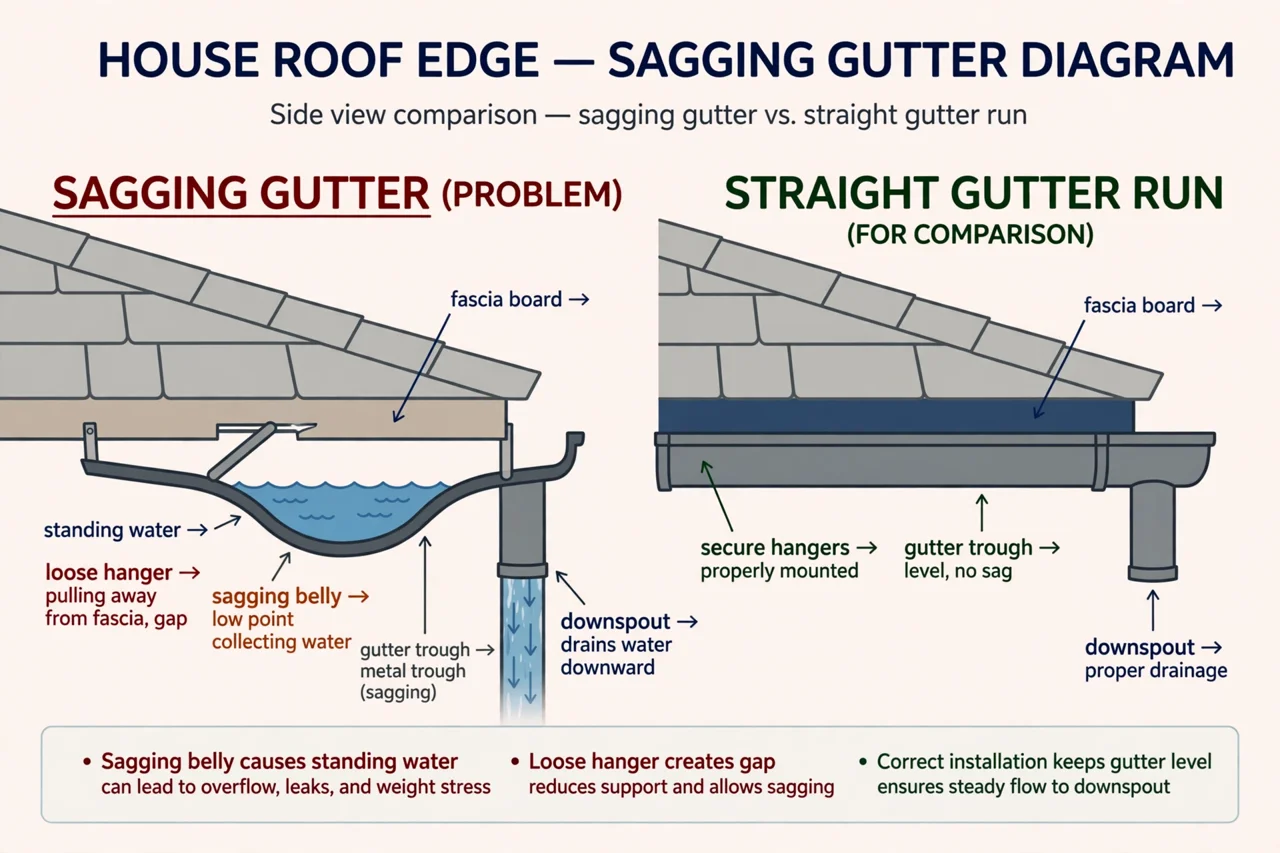
First, name what you are looking at
Sagging is three different problems that look alike from the driveway, and the fix depends on which one you have. A belly is a low dip in the middle of a run, between supports, where water stands after rain instead of running to the downspout. A pull-away is a visible gap between the back of the trough and the fascia, often with fasteners sticking out at an angle or missing entirely. Lost pitch is subtler: the run still touches the fascia, but it no longer falls toward its downspout, so water creeps the wrong way or sits along a whole length. All three end the same way — standing water, overflow, and weight — but a belly points at hangers, a pull-away points at fasteners or fascia, and lost pitch points at the original setting or at hangers that have slipped unevenly.
You can separate them from the ground, without climbing. Stand back and sight along the run the way you would sight along a fence line: a belly shows as a curve, a pull-away shows as a gap you can see daylight through, and lost pitch shows up during rain, when water spills over the front lip far from any downspout or sits in the trough long after the rain stops. Note which run it is, whether the problem is one spot or the whole elevation, and whether the fascia behind it looks stained or swollen. That short description is what turns a vague call into a visit that arrives with the right parts.
The six causes, in the order to check them
Most sagging gutters Biloxi MS homes develop come from this list, and the order matters: check weight first, then fasteners, then the wood, then the setting, then the size, then the metal. Working in that order keeps a simple cleaning-and-rehang from turning into a replacement quote, and keeps a real fascia problem from being hidden under new hangers.
1. Wet debris weight
This is the most common cause and the one Biloxi makes worst. A trough full of pine needles, leaves, and roof grit is already heavy; after a Gulf downpour it is saturated, and that wet mat sits in the run for days, pulling steadily on every hanger. The load is heaviest at outlets and in long runs between downspouts, which is why a belly so often forms mid-run rather than at a corner. Clearing the trough first is not just housekeeping — it is diagnosis. A run that springs back toward level once emptied was overloaded; a run that stays bellied after cleaning has a support problem underneath the debris.
2. Failed or underspaced hangers
Older systems often hang on long spikes driven through the trough into the fascia. Years of heat, vibration, and wet-debris weight work those smooth spikes back out, a fraction at a time, until the run hangs on fewer and fewer points. Hidden hangers screwed into the fascia hold far better, but only when they are close enough together for the load they carry: a run with hangers stretched too far apart will bow between them even with good hardware, and the bow deepens every season the trough stays full. When a visit re-hangs a run, the spacing question matters as much as the hardware choice — tighter spacing where the run carries valley water or heavy pine load, and every screw driven into solid wood, not just into the fascia board's face.
3. Soft or rotted fascia
Every hanger is only as strong as the wood it screws into. Fascia rots from the back, where overflow has run behind the trough for seasons, so the board can look painted and sound from the street while crumbling at the screw line. The tell is repetition: fasteners that keep backing out of the same stretch, paint flaking along one board, or a run that sags again months after a re-hang. Re-hanging onto soft wood buys weeks, not years. The wood has to be repaired first — that is a fascia and soffit repair job that comes before the gutter work, not after it — and only then will new hangers hold their pitch.
4. Lost or wrong pitch
A gutter does not need a steep slope; it needs a steady one, falling gently toward its downspout along the whole run. When hangers slip unevenly, or a run was set flat to begin with, water stops travelling and starts parking. Parked water is the start of the sagging cycle: it adds weight, the weight deepens the low spot, the deeper spot holds more water. Resetting the fall — about a quarter inch per ten feet, the same fall our gutter repair service sets when it re-hangs a run — breaks that cycle, but only once the hangers and fascia underneath are sound enough to hold the new setting.
5. Too much roof feeding too little gutter
Some runs sag because they were never sized for the roof above them. A long valley-fed plane pours a concentrated sheet of water into one trough, and if that trough is undersized or its downspout outlet is choked with debris, water backs up along the run and the standing load bends it down. The sag is the symptom; the mismatch is the cause. In that case re-hanging alone will not hold, because the next downpour recreates the same standing load. The durable fix pairs the re-hang with the sizing question — a larger profile or an added downspout where the roof demands it — which is the same sizing logic behind our seamless gutter installation service and the 5-inch vs 6-inch guide.
6. Bent, storm-damaged, or aged metal
Sometimes the trough itself has given up its shape. A limb strike, a ladder leaned hard on one span, or years of standing water can bend a section so it no longer holds a straight line no matter how well it is hung. Sectional runs have a second version of this problem: joints that have flexed open over time, so each section sags a little at its seams. When the metal is bent, split, or rusted through, re-hanging straightens nothing — the section needs replacing, and if the damage runs across most elevations, the honest answer is a full system rather than another round of patches. Our repair-or-replace guide walks through that threshold in detail.
| What you see | Likely cause | Usual fix |
|---|---|---|
| Belly mid-run, worse after rain | Wet debris weight, hangers too far apart | Clean out, re-hang with tighter spacing |
| Gap between trough and fascia | Spikes worked loose, fasteners failed | Replace fasteners with screwed hidden hangers |
| Same stretch sags again after a fix | Soft fascia behind the hangers | Repair the fascia first, then re-hang |
| Water sits along a whole length | Lost or flat pitch | Reset the fall toward the downspout |
| Sag under a valley, every storm | Undersized run or choked outlet for that roof | Re-hang plus resizing or added downspout |
| Bent, split, or rusted-through section | Storm damage or aged metal | Section or full-system replacement |
Why Biloxi runs sag faster than the national guides assume
Most sagging advice is written for leaf fall and snow load. Biloxi's load is different, and it arrives in a different rhythm. Longleaf and loblolly pines drop needles steadily rather than in one autumn week, so troughs in Woolmarket and the pine-heavy streets off the Back Bay gain weight all year, not once a season. Gulf downpours then saturate that mat in a single afternoon, turning a trough that looked merely dirty in the morning into a loaded one by evening. Salt air and older coastal stock add the third factor: fascia that has spent decades in humid, salty air softens sooner, so the wood fails while the metal still looks serviceable. A sagging guide that only mentions leaves and ice misses all three, and a cleaning rhythm built for another climate will always be a visit behind.
The practical consequence is timing. A run that sags a little in October, at the end of storm season, should not be left to ride out the winter rains on the assumption that it will hold until spring. Winter rain in Biloxi is steady enough to keep a bellied run loaded, and a loaded run keeps deepening. The cheapest moment to fix a sag is the moment it is noticed, while it is still one run and one set of hangers.
Re-hang, replace a section, or replace the system?
Use the metal and the wood as your two tests. If the metal is sound and the fascia is solid, re-hang: new screwed hangers, corrected spacing, reset pitch, and a water test that proves the run drains to its downspout. If one section is bent or split but the rest of the system holds its line, replace that section in the matching profile and size — a short run that does not match the rest of the house in size or profile will sag or overflow on its own terms. If sagging shows up across most elevations, the fascia is soft in several places, or repeated repairs in a few seasons have already cost a large share of a new system, replacement is the cheaper answer over the life of the house, not the more expensive one. Any quote that skips the fascia test and goes straight to new metal should be asked, in plain terms, what the new hangers will screw into.
One warning belongs in every sagging conversation: do not let a sagging run be “fixed” by sealant, by a screw driven through the front lip, or by a strap wrapped around the outside. Sealant seals joints; it holds no weight. A front-lip screw distorts the trough and creates a new low spot. A strap hides the gap while the fascia behind it keeps softening. The fix for a support failure is support — hangers, wood, and pitch, in that order.
Stopping the next sag before it starts
Prevention follows the same order as diagnosis. Keep the trough light: under pines, that means a cleaning rhythm set by what falls on the roof, not by the calendar on the fridge — a schedule our gutter cleaning service sets from the tree cover, not from a generic twice-a-year rule. Keep the outlets clear, because a clean trough feeding a choked outlet still backs up and still sags. After a re-hang, guards are worth weighing: a micro-mesh guard keeps the needle mat out of the trough in the first place, which is exactly the weight that caused the sag, and our gutter guard installation page explains which guard types actually hold up under pine load. And after every major storm, do the ground-level sighting check again — a new dip caught in the week after a storm is a re-hang, while the same dip found a year later may be a fascia job. For sagging gutters Biloxi MS homeowners have already had re-hung, this routine is the difference between a one-time fix and a repeat visit.
What not to do matters too. Do not climb onto a roof or a high ladder to inspect a sagging run yourself: a run that is pulling away can come down under a hand's weight, and a ladder leaned on a sagging trough adds the very load that finishes it. The ground-level checks in this guide — sighting the line, spotting the gap, watching where water spills in rain — give a visit everything it needs to arrive prepared.
Frequently asked questions
Why are my gutters sagging in the middle of a run?
A belly in the middle of a run usually means the hangers nearest that point have failed or were spaced too far apart, so the trough dips between its supports and holds water there. Wet debris makes it worse, because the standing water in the dip adds weight exactly where the support is weakest. Re-hanging the run with sound hangers into solid wood and resetting the fall toward the downspout usually corrects a single belly; a belly that returns after re-hanging points to soft fascia or a trough that has bent out of shape.
Can a sagging gutter be fixed without replacing it?
Yes, when the metal is sound and the problem is local. One sagging run with solid fascia behind it is a re-hang job: failed fasteners are replaced, the spacing is tightened where the run carries debris weight, and the pitch is reset so water flows to the downspout again. Replacement enters the picture when sagging shows up across most of the house, the trough itself is bent or split, or the fascia behind it is too soft to hold new fasteners.
How do I know if the fascia is too soft to re-hang a gutter on?
From the ground, look for paint peeling or flaking along the board behind the gutter, dark staining, and screws or spikes that keep backing out of the same spots. A closer check presses the board for soft or crumbling wood where the hangers sit. If the board gives under pressure, the wood has to be repaired before the gutter goes back up, because new hangers screwed into soft wood will pull out the same way the old ones did.
Will gutter guards stop my gutters from sagging?
Guards help with one cause and not with the others. By keeping pine needles and leaves out of the trough, a good guard cuts the wet-debris weight that drags runs down, which is a real benefit under Biloxi pines. Guards do not repair failed hangers, soft fascia, lost pitch, or a bent trough, and a guarded run that already sags will keep sagging until the support problem is fixed. Think of guards as prevention after a sound re-hang, not as the fix itself.
When is a sagging gutter urgent rather than a watch item?
Treat it as urgent when the run has pulled visibly away from the fascia, when water runs behind the gutter and down the wall during rain, or when a section looks ready to drop. Those signs mean the support has already failed and the next heavy downpour can finish the job, taking fascia and siding with it. A slight dip with no gap and no overflow can wait for a scheduled visit, but it should still be checked, because a dip that holds water only gets heavier.
Is a run sagging, pulling away, or holding water?
Call for a measurement anywhere in Biloxi — from Woolmarket to Back Bay. Name the run and what you see from the ground; the visit settles hangers, fascia, and pitch first, then repair versus replacement.
Call (228) 888-8061Related: Why do gutters overflow in Biloxi? · Gutter system parts in Biloxi · Signs you need new gutters · Gutter installation in Woolmarket · Gutter installation in Biloxi, MS