
Seamless vs Sectional Gutters in Biloxi: Which Wins?
Choosing between seamless vs sectional gutters Biloxi MS comes down to joints: seamless runs are formed on site in one piece, while sectional runs join a piece every few feet. For homes in 39532 and 39530, from Popps Ferry corridor to Back Bay, that difference drives leaks and upkeep.
The short answer is that seamless vs sectional gutters Biloxi MS buyers compare usually resolve in favor of seamless for a full replacement, and in favor of sectional only for a small, single-section repair. Every joint in a gutter run is a place water can escape, and a sectional run carries a joint every few feet while a seamless run carries none along a straight stretch. That one difference drives the leak, maintenance, and repair stories below — and it matters more here than in a dry climate, because Gulf downpours push a lot of water through every seam at once.
What Each Type Actually Is
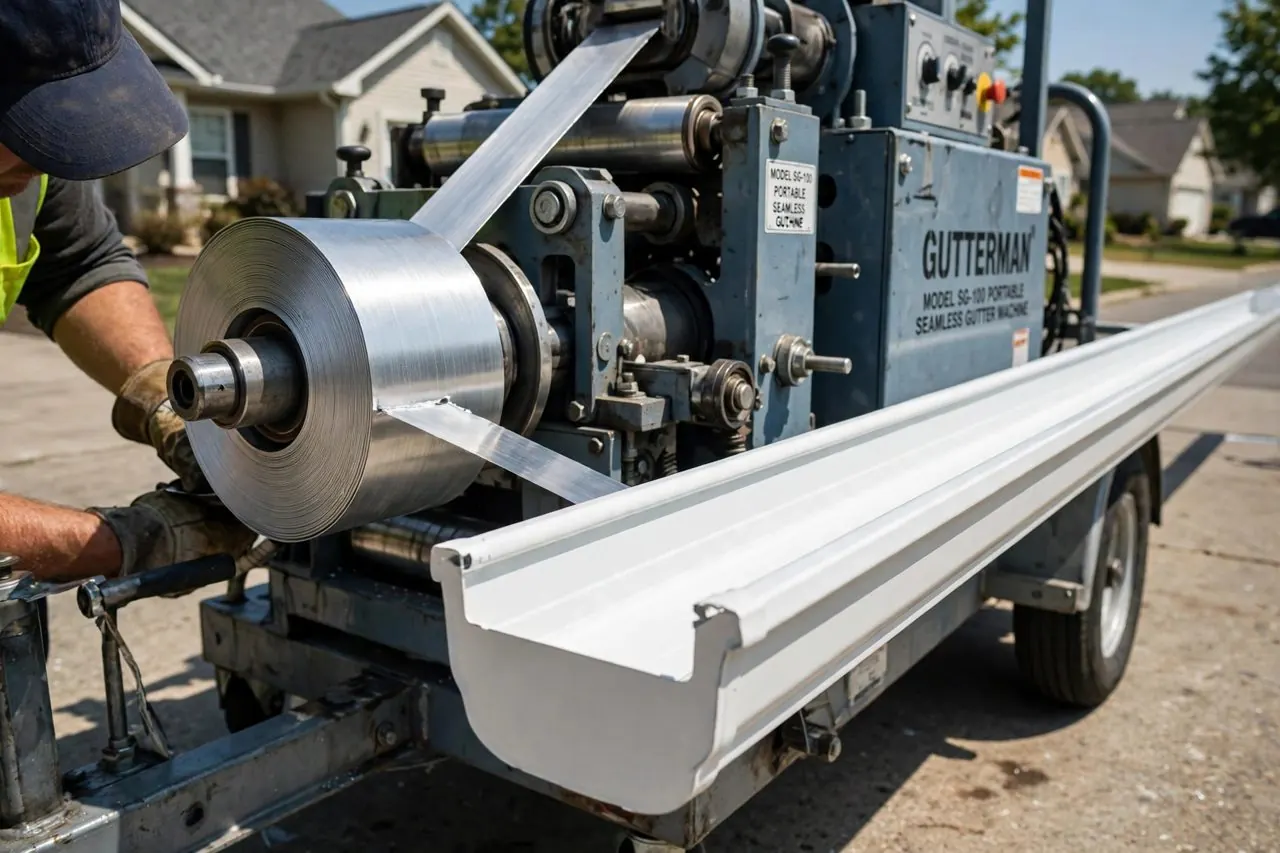
A seamless gutter is a single length of metal, usually aluminum, formed on site from a coil and cut to the measured length of one stretch of roofline. A long eave gets one long piece. That is the whole idea, and it is worth stating plainly because the name oversells itself: seamless does not mean joint-free. Corners, end caps, outlets, and downspout connections are still assembled and sealed on every system, seamless or not. What seamless removes is the row of joints spaced along every straight run — the joints most likely to work loose over time.
A sectional gutter works the other way around. It arrives as pre-made lengths, commonly ten feet, and the installer joins them end to end with slip connectors and sealant until the run is covered. Both types look similar from the driveway once they are up. The difference is hidden in the run itself: a sectional run on an average Biloxi home can carry a dozen or more joints, each one sealed, each one a future leak point, while the matching seamless run carries joints only where the roofline turns or meets a downspout.
Materials overlap but are not identical. Seamless systems are formed from coil metal, most often aluminum. Sectional systems come in aluminum, steel, and vinyl, and vinyl is sectional by construction — it is manufactured in pre-formed lengths and joined on site, so a vinyl system can never be seamless. If a quote ever describes vinyl as seamless, the description is wrong, and that alone is a reason to ask more questions.
The Comparison, Side by Side
Before the detail, here is the whole seamless vs sectional gutters Biloxi MS decision on one table. Every row below is expanded in the sections that follow, and the Biloxi notes say where Gulf conditions change the weight of each row.
| Factor | Seamless | Sectional |
|---|---|---|
| Joints along a straight run | None — one continuous piece | One every section, commonly every ten feet |
| Leak risk | Lowest at mid-run; corners and outlets still sealed | Highest — every joint is a potential leak |
| Sealant upkeep | Limited to corners, end caps, and outlets | Every joint needs checking, and resealing over time |
| Debris behavior | Smoother flow; fewer places for debris to catch | Debris and sediment collect at joints |
| Repair | Damage usually means patching or replacing a long run | One damaged section can be swapped on its own |
| Appearance | One unbroken line along the eave | Visible connectors at regular intervals |
| Installation | Professional only — needs a roll-forming machine | Can be fitted by a homeowner with common tools |
| Upfront cost factors | Higher — machine, on-site forming, crew | Lower — off-the-shelf sections, simpler fitting |
Leak Points: The Deciding Factor
Ask any installer what fails first on a gutter system and the answer comes back to joints. Sealant ages. It dries, shrinks, and cracks under sun and temperature change, and once it fails at a joint, water leaks at that joint and runs where it should not — down the fascia, behind the siding, and eventually toward the foundation. A sectional system multiplies that risk by the number of joints in the run, and a run with a joint every ten feet gives sealant a dozen chances to fail on a single side of a house.
That is also why the Biloxi angle matters. A seam that weeps a little in a light rain can fail outright in a Gulf downpour, when a large roof plane sheds a heavy volume through the same joints in a short burst. Homeowners usually discover a seam leak not during ordinary rain but during the heaviest rain of the season — which is also when a leak does the most damage to fascia and soil at the foundation. If your gutters already overflow or drip at the joints, our overflow diagnosis post walks through the five causes in order, and a leaking joint is one of the first things it checks.
Seamless does not eliminate leaks, and any post that claims it does is overselling. Corners still leak when their seals age, outlets still clog, and a seamless run hung with the wrong pitch still overflows. What seamless eliminates is the largest category of leak points — the mid-run joints — and that is why it is the default recommendation for a full replacement rather than a marginal upgrade.
Upkeep and Repair: Where the Trade-Off Reverses
Sectional gutters win exactly one round of this comparison, and it is worth naming honestly: repair. When one section of a sectional run is dented or split, that section can be unclipped and swapped without touching the rest of the run. A damaged seamless run usually means patching or replacing a much longer piece, because there is no joint to break the run at. For a home with one damaged stretch and an otherwise sound system, a sectional repair can be the sensible, cheaper fix.
Everywhere else, the upkeep story favors seamless. A sectional system asks for a joint inspection — sealant checked at every connector, resealed as it ages — while a seamless system asks for the same attention only at corners, end caps, and outlets. Under Biloxi pines the difference grows: pine needles and roof grit collect at sectional joints and form small dams that slow water and hold it against the sealant, which is one more reason the pine-needle problem and the joint problem arrive together. Our pine-needle guard guide covers what actually stops needles, but no guard removes the joint problem underneath — guards sit on top of the system, and the joints are still there.
The practical rhythm follows from that. A seamless system still needs cleaning and inspection — joints are fewer, not gone — but the inspection list is shorter and the resealing list is much shorter. A sectional system needs the same cleaning plus a joint-by-joint sealant check, and that check is the maintenance step most often skipped, which is how a small seam weep becomes fascia damage.
Cost Factors: Why Seamless Quotes Higher (and When It Pays Back)
Seamless costs more upfront for a straightforward reason: the gutter is manufactured at your house. The crew brings a roll-forming machine, forms each run to the measured length, and fits it in one piece. Sectional gutters skip that step entirely — the sections are bought ready-made and joined on site — so both the material handling and the fitting are simpler, and the quote reflects that. No dollar figures are quoted here, because a real quote depends on your footage, stories, and roofline, and any post that prints a single number for every home is guessing.
The payback question is about what happens after installation day. A sectional system carries a standing maintenance item — joint sealant that ages and needs attention — plus a higher chance of a seam-leak repair visit. A seamless system carries a higher first-day cost and a shorter maintenance list. Over a long stay in the home, the lower upkeep and fewer leak repairs are what close the gap; for a short stay or a single damaged section, the sectional repair can be the better spend. That is also why the gutter installation cost guide treats cost as factors, not a price list: footage, stories, roof complexity, gutter condition, and the type you choose all move the number, and a measured quote names each one.
One cost trap to avoid: comparing a seamless quote that includes new downspouts and fascia repair against a sectional quote that covers straight footage only. The two quotes are not measuring the same job. Ask every quote to name its footage, its type, its downspout count, and whether fascia work is included, separated, or confirmed as not needed — the same five-line check our guard-cost guide recommends for guard quotes applies here too.
Can You Install Seamless Gutters Yourself?
Not realistically. A seamless run has to be formed on a roll-forming machine, and that machine is professional equipment — it is not sold as a homeowner tool, and the formed length has to be handled, pitched, and hung as one long piece. A homeowner can buy sectional gutters at a home-improvement store and fit them with common tools, which is the genuine DIY route, and for a low, single-story run with simple rooflines it is a project many homeowners complete.
The honest limits of DIY sectional work are height, pitch, and fascia condition. A second story, a steep or valley-heavy roof, or fascia that is soft behind the old gutter all turn a weekend project into a fall or leak risk, and a DIY run hung with the wrong pitch will overflow no matter how good the sections are. If you are unsure about any of those three, a measurement visit answers them before anyone climbs a ladder — and our seamless gutter installation service is the professional route for the formed, one-piece system, sized from your roof plan rather than from store-bought lengths.
Which Type Fits Which Biloxi Home?
For a full replacement on a home you plan to stay in, seamless is the usual answer, and the case is strongest where Gulf rain is the main test: long roof planes, valley-heavy roofs, and homes under pines, where every joint is both a leak point and a debris trap. First-install buyers on the newer corridors — the Popps Ferry corridor and the Cedar Lake pocket, where homes are getting their first gutters rather than a replacement — are choosing between the two types with no old system to work around, and the same logic applies: fewer joints from day one means fewer seam problems over the life of the system. Our new-construction guide covers first-install sizing and timing for those homes.
Sectional makes sense in narrower cases: one damaged section on an otherwise sound system, a detached garage or outbuilding where appearance and long-term upkeep matter less, or a tight budget where the choice is sectional now versus living with a failing system. It also makes sense as a holding repair — replacing the worst section while planning a full seamless replacement later. What does not make sense is replacing an entire failing sectional system with another full sectional system and expecting a different result at the same joints.
Size still matters independently of type. A seamless system in the wrong size will overflow just like a sectional one, because capacity comes from width and downspouts, not from the absence of joints. If you have not settled size yet, our 5-inch vs 6-inch guide explains when Biloxi roofs need the larger profile, and a replacement decision should settle size and type together — the two choices answer different questions, and both need a yes before the order is placed.

When to Call Instead of Deciding From the Ground
Call when the comparison stalls — when one section leaks but the rest of the system looks sound, when two quotes name different types, or when you suspect the fascia behind the old gutters needs work before either type goes up. When you call about seamless vs sectional gutters Biloxi MS, bring three things: which runs leak or overflow, whether the damage is one section or the whole system, and how long you plan to stay in the home. Those three answers settle the repair-versus-replacement question first, and the type decision follows from it — not the other way around.
Frequently asked questions
Are seamless gutters better than sectional gutters?
For a full replacement, usually yes — because a seamless run has no joints along a straight stretch, and joints are where sectional systems leak, collect debris, and need resealing. Sectional still wins for a single-section repair, where swapping one damaged piece beats replacing a long run. The right answer depends on whether you are repairing one section or replacing the whole system.
Why do sectional gutters leak more than seamless gutters?
Because every joint is sealed with sealant, and sealant ages — it dries, shrinks, and cracks under sun and temperature change. A sectional run carries a joint every few feet, so it gives sealant many chances to fail, while a seamless run carries joints only at corners, end caps, and outlets. Heavy Biloxi rain pushes a large volume through those joints at once, which is when a weakened seam usually shows itself.
Can I install seamless gutters myself?
Not realistically. Seamless gutters are formed on site with a roll-forming machine, which is professional equipment, and each run must be handled and hung as one long piece. Sectional gutters are the DIY option — they are sold in ready-made lengths and fitted with common tools — but height, steep roofs, and soft fascia are real limits, and a run hung with the wrong pitch will overflow regardless of type.
Do seamless gutters cost more than sectional gutters?
Yes, upfront — because the gutter is manufactured at your house on a forming machine, with a crew fitting each run in one piece, while sectional gutters arrive ready-made and join on site. The gap narrows over time because seamless systems carry a shorter maintenance list and fewer seam-leak repairs. No single price fits every home; a real quote is built from your footage, stories, roof complexity, and whether fascia work is needed.
How long do seamless gutters last compared with sectional gutters?
Seamless systems generally last longer, because the failure that ends most sectional systems — sealant giving out at joint after joint — barely applies to them. Corners, outlets, and downspouts still age on both types, and cleaning and inspection still matter. Our lifespan guide covers what actually shortens or extends a seamless system in Biloxi conditions, from pine debris to fascia condition.
Deciding between seamless and sectional?
Call for a measurement anywhere in Biloxi — from the Popps Ferry corridor to Back Bay. The visit settles repair versus replacement first, then size and type.
Call (228) 888-8061Related: 5-inch vs 6-inch gutters · How long do seamless gutters last? · Gutter installation on the Popps Ferry corridor · Gutter installation in Biloxi, MS